
There are three holidays celebrated during this time of the year Christmas, Hanukkah, and Kwanzaa. Happy Kwanzaa to all who are beginning this meaningful celebration today!
I grew up celebrating Christmas and I’m familiar with Hanukkah. I have cousins who are Jewish and my family and I participated in a number of Hanukkah celebrations. Today is the beginning of Kwanzaa, a holiday I know very little about, so I decided it’s time for me to learn about it.
Kwanzaa is a seven-day celebration observed from the 26th of December to the 1st of January. It was started by Dr. Maulana Karenga in 1966 to celebrate and honor African heritage in African-American culture. It has its roots in the black nationalist movement of the 1960s. The name Kwanzaa comes from the Swahili phrase matunda ya kwanza, meaning “first fruits of the harvest.” The colors of Kwanzaa are black, representing the color of the people; green, representing the hope for the future; and red, representing the blood shed in the struggle for freedom.
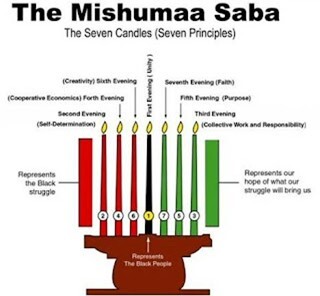
The Seven Principles of Kwanzaa
Kwanzaa celebrates the seven principles of Kwanzaa or Nguzo Saba. There seven principles comprise Kawaida, a Swahili word meaning “common”. Each of the seven days is dedicated to one of these principles:
- Umoja (Unity): To strive for and to maintain unity in the family, community, nation, and race.
- Kujichagulia (Self-Determination): To define and name ourselves, as well as to create and speak for ourselves.
- Ujima (Collective Work and Responsibility): To build and maintain our community together and make our brothers’ and sisters’ problems our problems and to solve them together.
- Ujamaa (Cooperative Economics): To build and maintain our own stores, shops and other businesses and to profit from them together.
- Nia (Purpose): To make our collective vocation the building and developing of our community in order to restore our people to their traditional greatness.
- Kuumba (Creativity): To do always as much as we can, in the way we can, in order to leave our community more beautiful and beneficial than we inherited it.
- Imani (Faith): To believe with all our hearts in our people, our parents, our teachers, our leaders, and the righteousness and victory of our struggle.
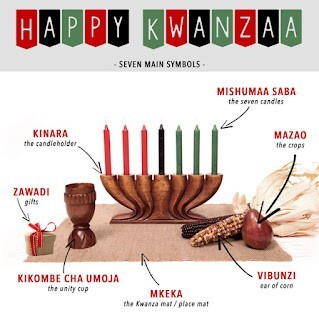
The Seven Symbols of Kwanzaa
The celebratory symbols of Kwanzaa include a mat (Mkeka) on which other symbols are placed: a Kinara (candle holder), Mishumaa Saba (seven candles), mazao (crops), Muhindi (corn), a Kikombe cha Umoja (unity cup) for commemorating and giving shukrani (thanks) to African Ancestors and Zawaki (gifts).
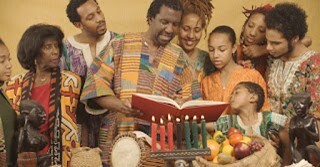
Families celebrating Kwanzaa decorate their homes with objects of art, colorful African cloth such as kente, especially the wearing of kaftans by women, and fresh fruits that represent African idealism. A Kwanzaa ceremony may include drumming and musical selections, a discussion of the principle of the day, lighting a candle in the Kinara, story telling and poetry. On the sixth night, the 31st of December, of Kwanzaa there is a big feast called Karamu and on the seventh day, the 1st of January, gifts are given. Gifts are usually homemade and encourage growth, self-determination, achievement and success.
To those of you who celebrate this holiday I wish you and your family a very Happy Kwanzaa.
